Two Reports. Two Different Stories. (Again.)
ADP reported 90,000 private-sector jobs in September, a three-month high. BLS reported just 29,000 total jobs, and revised August down from 162,000 to 133,000. Unemployment ticked up to 4.2%.
Your monthly labor market index—built for talent leaders
Register for Our Next BriefingWatch the Talent Market Index for October 2026
Market analyst's callout board for October 2026
ADP reported 90,000 private-sector jobs in September, a three-month high. BLS reported just 29,000 total jobs, and revised August down from 162,000 to 133,000. Unemployment ticked up to 4.2%.
More industries cut jobs than added them in September, as the BLS diffusion index fell to 49.0 from 57.6. Even healthcare slowed, adding just 17,000 jobs, half its usual pace. Nursing and residential care lost 9,000.
TMI shows recruitment advertising prices rose in six of nine job categories, with eight still above year-ago levels. Despite some signs of relief, hiring costs remain elevated across much of the market.
The Talivity Talent Market Index (TMI) offers a fresh perspective on talent supply and demand dynamics across industries. It tracks the fluctuating prices employers pay to attract talent through paid advertising across diverse media channels.
Current month performance indicators for October 2026
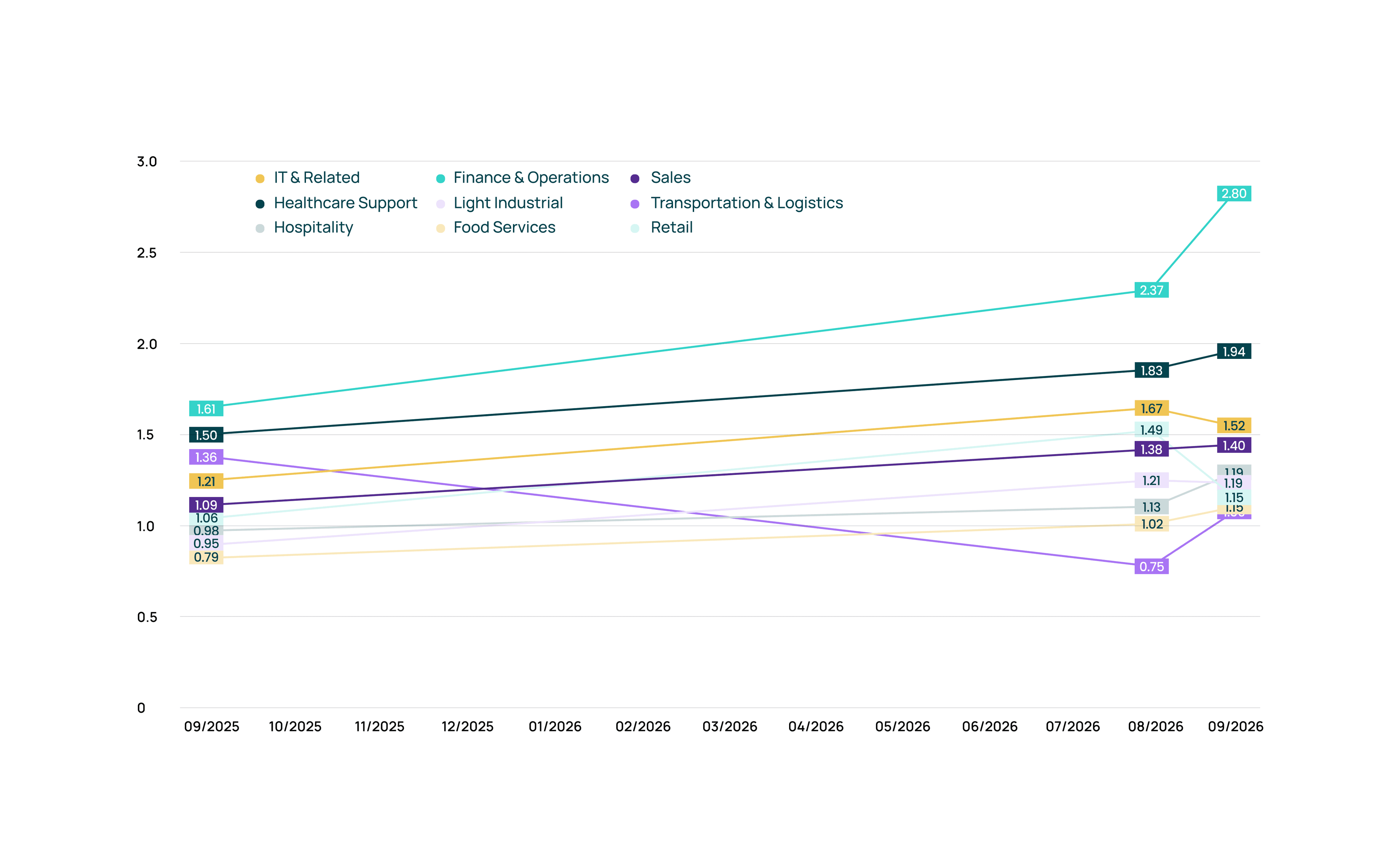
View Data As ChartFinance & Operations, Healthcare, and IT & Related are where employers face the steepest prices to attract talent, and all three are up from a year ago. Finance & Operations stands well above the rest even as financial-sector employment shrinks. It rose another 18% this month and is up 74% from a year ago, a sign that demand is concentrating in hard-to-find profiles. Healthcare rose 6% this month and is up 29% from last year, notable because healthcare hiring slowed to about half its usual pace in September. Competition for clinical talent isn’t letting up. IT & Related eased 9% this month, but it’s still up about 25% from a year ago, and active tech postings are at their highest level in over three years, so competition for engineers is far from over.
Transportation & Logistics jumped 45.33%, but that’s a rebound off last month’s low, not a new trend. At 1.09, it’s still the lowest index on the board and the only segment cheaper than a year ago. Retail fell 22.82%, the biggest drop on the board, even as retail employment added about 6,000 jobs. That gives seasonal hirers a more favorable window to move early. Finance & Operations (+18.14%) and Food Services (+12.75%) also climbed sharply. IT & Related eased 8.98%, but active tech postings are at their highest level in over three years, so the relief may not last.
Finance & Operations shows the steepest annual climb at +73.91%, followed by Food Services (+45.57%) and Healthcare (+29.33%). Finance & Operations is up even though financial-sector employment is down 129,000 jobs since May of last year. Food Services sits second, and with restaurants adding 59,000 jobs in August, the hourly label shouldn’t fool anyone: it’s one of the more expensive markets to recruit in right now. Eight of nine segments still cost more to recruit in than a year ago. Transportation & Logistics (-19.85%) is the only exception, and Retail (+8.49%) posted the smallest increase of the segments that rose.
The labor market is getting harder to read. ADP reported 90,000 private-sector jobs in September, while BLS reported just 29,000 and unemployment ticked up to 4.2%. The gap points less to one report being wrong than to employers getting more selective. Fewer industries are adding jobs (the BLS diffusion index fell to 49.0 from 57.6), and even healthcare slowed to about half its usual pace, so hiring is concentrating, not just cooling. Yet TMI prices rose in six of nine segments. Less hiring doesn’t mean less competition.
Detailed insights by sector for October 2026
Subscribe to our insights and stay ahead of the curve with expert perspectives on talent acquisition, employer branding, and workforce strategies.